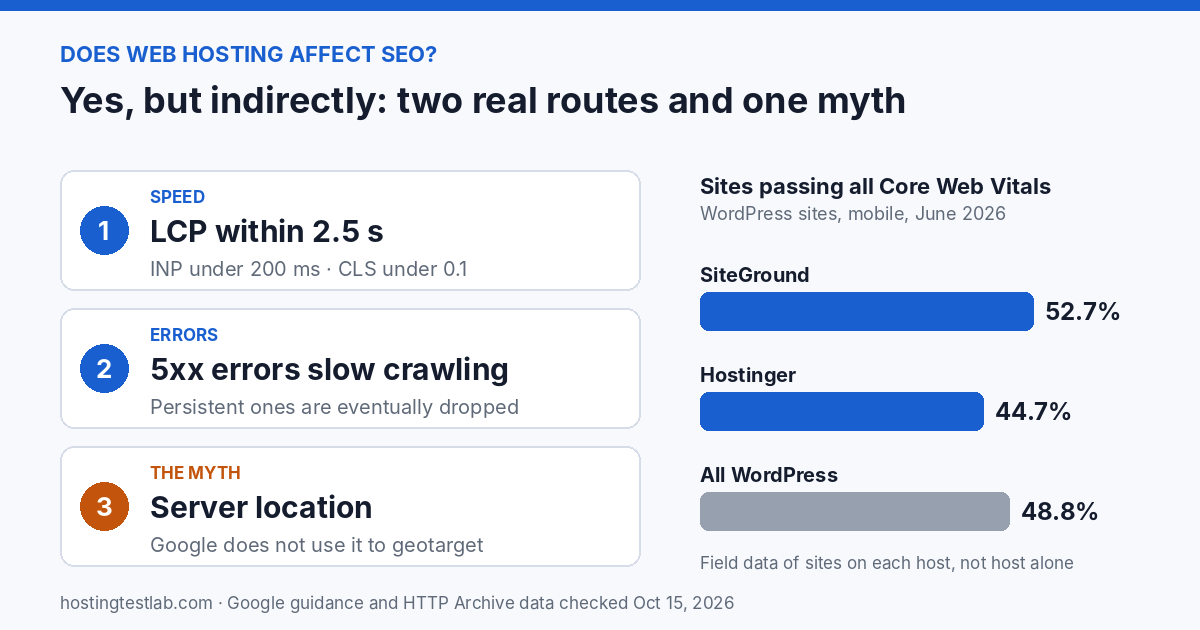
Does web hosting affect SEO? Yes, but indirectly. Google does not rank hosting companies. It measures how fast and how reliably your pages load, and a weak host can hurt both. A good host will not rescue thin content, and a slow one can hold back good content.
Google’s guidance was checked on October 15, 2026 on its Search Central pages. Host figures come from HTTP Archive field data for June 2026 (as reported by HostingStep), Mantrabrain and Cybernews tests, and the hosts’ own pages.
How web hosting affects SEO through page speed
Google’s Core Web Vitals page sets three “good” thresholds: Largest Contentful Paint within 2.5 seconds, Interaction to Next Paint under 200 milliseconds and Cumulative Layout Shift under 0.1. Your host mostly influences the first one, because a page cannot start to paint until the server has answered.
Google’s page experience guidance puts speed in perspective. It says Google’s systems look to reward good page experience, but that relevance comes first, even when a page is slow. Good scores help most when many pages answer the same query equally well. For a niche affiliate site with strong content, a slow host costs less than weak content does. Where several sites compete for one query, it can decide who ranks higher.
Uptime, server errors and crawling
Downtime matters more than a few hundred milliseconds. Google’s documentation says server errors (5xx) and rate limiting make its crawlers slow down. URLs that keep returning errors are eventually dropped from the index, and Google ignores any content it received with the error. The page gives no number of days, so one outage of an hour is not a ranking event, while a host that fails repeatedly is. Crawling recovers gradually once the server answers normally again. For a recent real example, see what happened in the Namecheap outage of August 2026.
Google’s crawl budget guide also says crawl limits fall when response times rise. That guide is written for sites with about 10,000 or more unique pages that change daily, or about 1 million pages that change weekly. A typical new affiliate site is far below that, so crawl speed is rarely the problem.
What hosting does not change
Server location is not a geotargeting signal. Google’s John Mueller said in February 2022 (reported by Search Engine Journal) that Google does not use the server’s location for geotargeting. A US site on a European server is not penalized for it, although visitors far from the server load pages more slowly. Plan type does not rank a site either: no Google page I checked names a hosting company, plan or server type as a ranking input.
Hostinger vs SiteGround: what the data shows
HTTP Archive collects Chrome field data from real visitors, grouped by the platform a site runs on. HostingStep reported these June 2026 figures for WordPress sites on each host:
| Measure (June 2026) | Hostinger | SiteGround | All WordPress sites |
|---|---|---|---|
| Pass all Core Web Vitals, desktop | 52.7% | 52.6% | 53.3% |
| Pass all Core Web Vitals, mobile | 44.7% | 52.7% | 48.8% |
| Good server response, desktop | 40.9% | 28.4% | 33.2% |
| Sites measured | 484,335 | 191,306 | Not stated |
These percentages describe the sites on each host, including heavy themes and plugins, not the host alone. Even so, the pattern is clear. Desktop passing is level at 52.7% and 52.6%. SiteGround passes 8.0 points more often on mobile, and Hostinger has 12.5 points more sites with a good server response on desktop.
| Source | Method and period | Hostinger | SiteGround |
|---|---|---|---|
| Mantrabrain | Hourly TTFB for 14 days from US East, Pingdom uptime; June 2026 | 180 ms, 99.99% uptime | 240 ms, 99.99% uptime |
| Cybernews | Pingdom and GTmetrix; no host-specific test period stated; updated October 2, 2026 | 207 ms TTFB, 100% uptime | 90 ms TTFB, 99.99% uptime |
The two tests disagree on which host answers faster, and neither says which plan it tested. Both put uptime at 99.99% or better. Taken together, neither host separates itself on speed or uptime, so your theme, plugins and caching will decide more than the choice between them.
What to check in a host for SEO
- A CDN: both hosts list a CDN on their entry plans, Hostinger Premium and SiteGround StartUp.
- A US server near your readers: Hostinger lists Phoenix, Boston and Asheville for web hosting, and SiteGround lists Ashburn, Council Bluffs, Dallas and Los Angeles. Both let you choose and change the location later.
- Caching: SiteGround lists multilevel caching and its Speed Optimizer plugin on every plan, and Hostinger lists LiteSpeed servers and object caching.
- A price you can keep paying: Hostinger Premium is $2.49 a month on a 48-month term and renews at $10.99. SiteGround StartUp is $2.99 a month on a 12-month term and renews at $17.99.
Check Hostinger plansVisit SiteGround
Who should worry about hosting for SEO
- A new blog with few posts: do not switch hosts for SEO. Content and links matter more at this size.
- A site that keeps going down: change host. Repeated 5xx errors are the one hosting problem Google documents as leading to dropped URLs.
- A store or ad-heavy site with slow mobile pages: test your pages against the 2.5-second and 200-millisecond thresholds before blaming the host.
So, does web hosting affect SEO?
For most affiliate sites, does web hosting affect SEO enough to matter? Only at the extremes. Reliable hosting with a CDN and a nearby US server keeps you out of trouble, and after that your theme, images and plugins decide your scores. Read the Hostinger review, the SiteGround review or the SiteGround vs Hostinger comparison to choose between the two.
Frequently asked questions
Does changing hosts hurt rankings?
Not by itself. Mueller said Google may crawl a moved site less often for a short time, then speeds up again. A move to a far-away server can make pages load slower for visitors, which is what could affect page experience.
Does a CDN help SEO?
A CDN can help by serving pages from servers near each visitor, and Mueller said serving from several locations is fine for Google. It is a speed tool, not a ranking switch.
Do Hostinger and SiteGround include HTTPS?
Yes. Hostinger’s page says a free SSL certificate is installed automatically on every plan, and SiteGround’s page lists a free pre-installed wildcard SSL on all three plans.